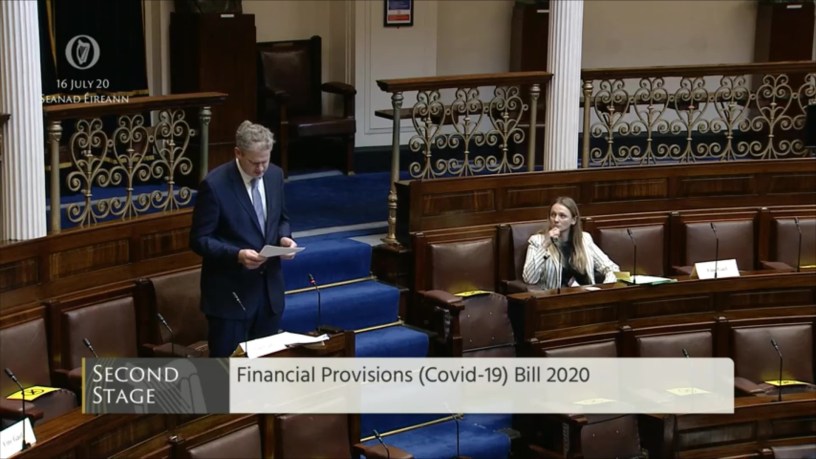
On Thursday we debated and passed the Financial Provisions (Covid-19) 2020 Bill. The Bill empowers the Minister for Finance to enter into agreements to contribute to and access two EU support measures for workers and businesses due to the ongoing impact of Covid-19.
Financial Provisions (Covid-19) 2020 Bill
The COVID-19 coronavirus does not discriminate between countries or nations, just as it does not discriminate in terms of the individuals and families that have been impacted by this dreadful virus.
Few of us have lived through such an unprecedented crisis as the one caused by COVID-19 and such is the scale of the crisis, the sheer impact it is having on our country and on all the countries of Europe, that a collective response is needed from the Member States of the European Union.
The bill before us today will empower our government to participate on behalf of the people in this collective response to COVID-19.
It achieves two objectives:
Firstly, it will enable the State to take part in the European Istrument for temporary support to mitigate unemployment risks in an emergency following COVID-19 outbreak – or SURE for short.
Secondly, the bill will empower the State to participate in the European Investment Bank’s Pan-European Guarantee Fund. Through this fund financial supports will be available to Irish businesses and organisations to help tackle the enormous challenges that COVID-19 has brought.
The current government has continued the work of the previous government in terms of introducing and maintaining supports to businesses and workers. Supports including the COVID-19 Working Capital Scheme, the Future Growth Loan Scheme, the Restart Grant, the Online Retail Scheme, the Pandemic Unemployment Payment and the Temporary Wage Subsidy Scheme, among others, are all helping businesses, workers and households to weather this unparalleled crisis.
However, in the same way that COVID-19 transcends national borders our armoury of supports should do the same.
As Regulation 672 of 2020 notes this is an exceptional situation which is beyond the control of EU Member States, has immobilised a substantial part of the workforce and has led to a sudden and severe increase in public expenditure on areas including employment and business supports, as well as health and social care.
The SURE Instrument, the European Council agreed, will help all of the Member States respond in a “co-ordinated rapid and effective manner and in a spirit of solidarity”.
Indeed, the financial assistance that will be provided through the SURE Instrument will not be available until all Member States have signed the guarantee agreement. This underpins the solidarity of this support which will provide up to €100 billion for all Member States.
As Section 4 of the bill states Ireland’s contribution to the SURE Instrument will be over €483 million and in that context, coupled with the longevity of the commitments involved – out to 2053 – it is important that this bill be enacted with this scrutiny such obligations demand.
Ordinarily, of course, regulations have direct effect and do not need to be transposed. Given the nature of the financial obligations and the commitments being entered into it is reassuring that the Oireachtas is the body empowering the Finance Minister, in line with our Constitution, to enter into this guarantee agreement.
The Pan-European Guarantee Fund will see us contribute up to €167.5 million to another central fund designed to support viable businesses and organisations. The fund is structured in such a way so as to be available only to those Member States who join.
Here, the fund will be administered by the Strategic Banking Corporation of Ireland, the SCBI, which already operates a number of supports from government departments for businesses, in particular SMEs.
The evolving and uncertain path of the Coronavirus is compounding difficulties, particularly in some sectors. Hospitality and tourism, arts and culture, among other sectors, have been in effect decimated by COVID-19.
I have spoken to business-owners from different sectors, SMEs and from larger companies in Galway. I’ve heard from workers in the arts and culture sector and from operators in the hospitality sector – sectors that are of crucial importance to the wellbeing – economic and social – of Galway and the West.
Everyone I have met and have spoken to understands the seriousness of this pandemic, the dangers including the threat to life of this virus.
If the price to keep citizens safe is the continued curtailment of economic activity, then we need to expand the supports available.
This bill involving the SURE Instrument and the EIB’s Guarantee Fund broadens the supports that we, as a country, have already introduced. The bill facilitates greater certainty and reassurance.
However, I expect our government to grasp the opportunities and to make use of the SURE Instrument and the Guarantee Fund. I expect our government to supplement and expand our own national supports to include supports for seasonal workers, workers in tourism and hospitality and members of the arts and creative community.
I also expect that our government will access the Guarantee Fund to provide greater financial supports for businesses and organisations whose success directly impacts the communities in which they operate.
The fact that our State has been able to allocate resources and borrow funds for supports reflects the careful and prudent management of our economy over the last number of years. But just as with our efforts to suppress COVID-19 we cannot be complacent. Borrowing will not be an option for the longer term, and we must be ready to access the EU supports for the good of our businesses and workers across the country.
 Seán Kyne