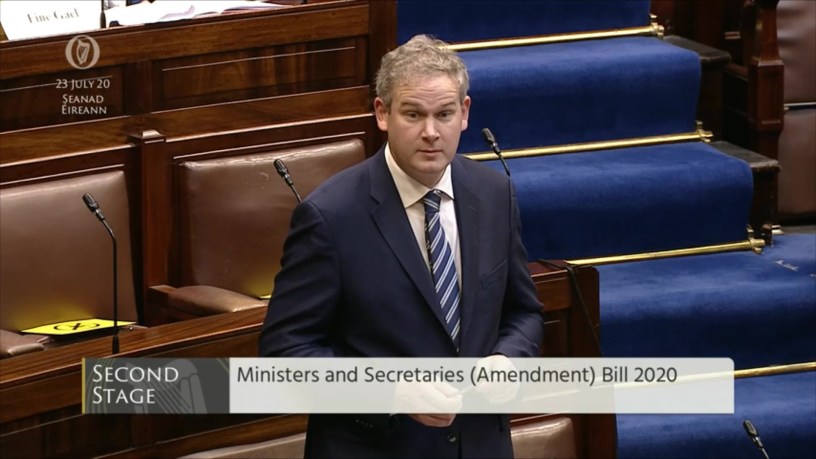
As Spokesperson for Public Expenditure and Reform and Gaeltacht Affairs, I took part in the debate on the Ministers and Secretaries Amendment Bill which sets up the Department of Further and Higher Education, Research, Innovation and Science.
Among the issues I raised were:
- The number of new departments;
- Funding for the Higher and Further Education Sector;
- The need to support fundamental research and support more researchers
- The need to have a separate, independent Chief Scientific Adviser to the Government
The Ministers and Secretaries Amendment Bill is a short, technical bill but its consequences will be far-reaching. The bill establishes a new government department: An Roinn Breisoideachais agus Ardoideachais, Taighde, Nuálaíochta agus Eolaíochta or the Department of Further and Higher Education, Research, Innovation and Science.
The establishment of this new department will bring to 18 the number of government departments. Several ministers will now be responsible for two departments each which is a mammoth task.
While I welcome this new focus on higher and further education and on research there are many other areas that are deserving of such a focus.
The issue of our aging population and the needs of older people is one example. The number of people over 65 is growing rapidly and within a decade one in six people in Ireland will be over 65 while there will be over a quarter of a million people over the age of 80.
This brings into sharp focus the challenges in terms of healthcare, housing, transport as well as social protection. So, there are many areas that are equally deserving of the attention that a designated government department brings.
However, the establishment of this new department is an opportunity and should be viewed as such.
There are a number of issues which I wish to raise including the funding of the overall sector, the type and shape of the sector we have and the funding strategies pursued regarding research.
The sustainability and funding of the Higher education sector is an issue which has not yet been properly addressed. We have had numerous reports, reviews and debates but as of yet few solutions.
I think the development of this new Department is an opportunity to recognise the value of higher and further education to individuals, the economy and wider society.
The number of students is increasing, estimated by the Department of Education to exceed 220,000 students by 2022. That projection was made long before COVID-19 and its impact on our economy. I have no doubt that this number will increase with the need for re skilling, training and upskilling.
In July 2016 the Expert Group on Future Funding for Higher Education concluded that an extra 1 billion euro in funding is needed each year to maintain and improve higher and further education.
The Irish universities Association estimates that Irish universities – not including ITs or technological universities – generate about nine euro for every one euro that the State invests.
Aside from this, coming from Galway, I know first-hand the positive impact of NUI Galway and GMIT, among others, such as the Galway Technical Institute, on our city and county and the wider region. I cannot overestimate the value of being home to world class higher and further educational institutions.
The positive impacts are everywhere to be seen –
from job creation and entrepreneurship,
the connection between research and the life sciences sector, including pharmacology and medical technologies,
the role of research in the agriculture and marine sectors,
and, of course,
the crucial research and innovation in the development of renewable energy sources and low carbon technologies.
In addition, with a strategic approach, higher education institutions can help develop nationally important schools or colleges in more rural communities. Examples include NUIG’s Acadamh in Carna and An Cheathru Rua and GMIT’s National Centre for Excellence in Furniture Design and Technology located in Letterfrack in Connemara.
A second point I wish to make is the opportunity for this new department to develop and nurture a culture of continuous and life-long learning. Such a culture is necessary not just for economic terms, with the changing and evolving workplace, but also for the personal development of each and every citizen.
If the Covid-19 pandemic has shown us anything it is the ability with which we can adapt to new approaches and adopt new ways of communicating. Blended learning is, I believe, here to stay.
However, one cannot beat the benefits of the classroom and the importance of physically attending courses. Notwithstanding the current situation with Covid-19, the facilities that our higher and further education institutions have should be in continuous use.
I also want to acknowledge and welcome the expansion, in recent years, of the Springboard Programme. This is a Programme which has been helping people to re-skill and up-skill in areas of high need or demand over the last decade. And on several occasions, it has been broadened and expanded so that the courses are available, at reduced cost or free-of-charge, for people at work as well as free-of-charge for people who are unemployed.
The third broad point I want to raise today is the approach that has been taken to funding research at our higher education institutions.
Third level researchers need sustained and regular opportunities to apply for and obtain individual-led funding over their careers.
In recent years, it has become clear that demand for funding greatly exceeds supply. Researchers spend too much of their time on funding applications from funds where the success rate is low.
Many excellent researchers struggle to secure funding to maintain their international competitiveness and their ability to train and provide PhDs and post-doctorates for academics and people from various industries.
Individual funding is critical to generating new ideas, making scientific breakthroughs, identifying new directions in science and engineering and fostering innovation.
There has been a focus in recent years in funding for specific and defined areas as well as a tendency to provide large amounts of funding to a small number of researchers. We can see this clearly through the approach taken by Science Foundation Ireland.
Such an approach omits thousands of researchers who, with some State support, could leverage further funding for the Irish research sector.
If we want our universities and ITs to remain competitive and to be centres of internationally-important and significant research then we need to provide an increased level of core funding.
This funding would be used for capital and physical infrastructure and technical supports and should include clear ringfencing of funding for unrestricted researcher-led research – the type of research that often leads to great technological and scientific advances such as those in healthcare and engineering and so forth.
We also need a robust evaluation of Science Foundation Ireland and the research direction in which our country is heading.
The separation of the role of Chief Scientific Adviser from the role of Director of Science Foundation Ireland should also be pursued. The role of Chief Scientific Adviser to the Government of Ireland should be independent of any of the funding organsiations.
Furthermore, we need an information campaign to raise awareness of the importance of higher and further education to our economy, to our society and to individuals.
We need a co-orindated approach to the funding of and orgnisation of our higher and further education sector. An approach that encourages personal development, fosters a culture of continuous learning and supports and nurtures pioneering innovation and research.
I believe that the establishment of this new department presents a golden opportunity to achieve all of this and more and I wish the Ministers and the officials well and look forward to working with them.
 Seán Kyne