Humanitarian Assistance Scheme available for Clifden householders affected by flooding
Following representations to Minister for Social Protection, Heather Humphreys I can confirm that the Humanitarian Assistance Scheme has been made available to householders in Clifden who have been affected by the unexpected and devastating flooding in the town.
The scenes of the flooding in the town showed clearly the damage caused to family homes by the torrential rains and the over-topping of the Owenglen River. Once the flooding subsides the clean-up operation will begin and through the Humanitarian Assistance Scheme support will be provided to the householders.
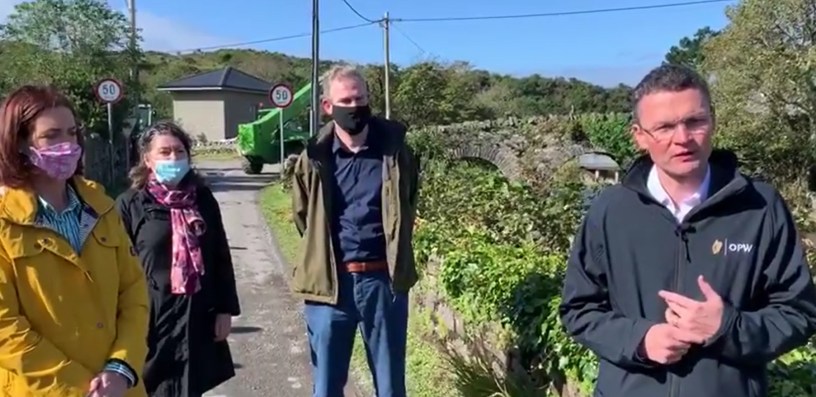
On Wednesday night and Thursday morning I accompanied Minister of State for the OPW, Patrick O’Donovan, Minister Hildegarde Naughton and Councillor Eileen Mannion on a visit to the areas affected and to meet with householders and council staff. We need to examine the root cause of this damaging flooding and carry out works as necessary.
Below is an outline of the Humanitarian Assistance Scheme, operated by the Department of Social Protection. The Scheme has been activated for the householders in Clifden and the surrounding areas who have been affected by the flooding which occurred on Tuesday night/Wednesday morning.
The Intreo Office in Clifden may be contacted by phone on 095 22210 or email clifden@welfare.ie.
Humanitarian Assistance Scheme – Department of Social Protection
- The Department of Housing, Planning and Local Government is the lead Department for response to severe weather emergencies. However, the Department of Social Protection has an important role to play in assisting households in the immediate aftermath of emergency events through the Humanitarian Assistance Scheme.
- This Scheme was approved by Government in November 2009. Its purpose is to prevent hardship by providing income-tested financial support to people whose homes are damaged from flooding and severe weather events and who are not in a position to meet costs for essential needs, household items and structural repair.
- Following a severe weather event Community Welfare Service staff of the Department closely monitor the situation on the ground and engage with the relevant local authorities and other agencies. Emergency clinics may be opened and home visits undertaken.
- In dealing with emergency events the Department generally adopts a three stage approach as follows:
- Stage 1 provides emergency income support payments (food/clothing/personal items) in the immediate aftermath of the event.
- Stage 2 involves the replacement of white goods, basic furniture items and other essential household items.
- Stage 3 is to identify what longer term financial support is required, including plastering, dry-lining, relaying of floors, electrical re-wiring and painting.
- Levels of payment under the scheme depend on the relative severity of damage experienced and the household’s ability to meet these costs ensuring that the funding is appropriately targeted.
- The means assessment for Humanitarian Assistance is more generous than that applied under means tested Social Welfare payments in general. The basic principle of the income test is that individuals and families with average levels of income will qualify for assistance, including non-Social Welfare recipients.
- The scheme does not cover risks that are covered by insurance policies or cover business or commercial losses.
- DEASP has a contract in place for the provision of loss adjusting services in respect of the humanitarian assistance scheme to support the assessment of damage to individual households in cases where structural repairs are necessary and the cost is estimated in excess of €5,000.
- The scheme has been activated to provide support to homeowners affected following recent flooding in West Cork and after Storms Ellen and Francis. It is also available to provide support to those in Clifden, Co Galway.
- Anyone affected by flooding following the severe weather is advised to contact the Community Welfare Service at their local Intreo Office.
 Seán Kyne